


Dracula by Bram Stoker, published in 1897 by Archibald Constable and Company, London, is the foundational vampire novel in English literature. It has never been out of print. This page is a complete reference for the original text — covering the plot, every character, Bram Stoker's biography, the first edition, and where to read or collect the novel today.
The novel is built entirely from diaries, letters, telegrams, newspaper clippings, and phonograph recordings. There is no single narrator. Stoker spent seven years constructing it and anchored every date to the real calendar of 1893. Jonathan Harker travels to Transylvania to close a property deal for a foreign nobleman. What follows is one of the most precisely designed horror narratives in the English language.
Dracula opens on May 3 with Jonathan Harker traveling from London into Transylvania to conclude a property transaction for Count Dracula. After crossing the Borgo Pass, he is taken to Castle Dracula. What begins as a formal stay becomes confinement. Harker documents the Count through direct observation: no reflection in the mirror, extraordinary physical strength, the ability to scale walls, control over wolves, and strict nocturnal activity. The castle operates as an active predatory system; the presence of the three women confirms it. During Harker's imprisonment, Dracula prepares his relocation to England by arranging the shipment of multiple boxes filled with his native soil.
Harker eventually escapes by descending from the castle structure. He survives, reaches safety, and is taken to a convent, where Mina Murray joins him. They marry and later return to England.
At the same time, Mina is in Whitby with Lucy Westenra. Lucy develops a pattern of somnambulism, leaving her room at night and walking toward the cemetery overlooking Whitby Abbey. During one of these episodes, Mina finds Lucy on a bench near a tomb, with a dark figure bent over her. This marks the first direct feeding event. Lucy's condition begins to deteriorate.
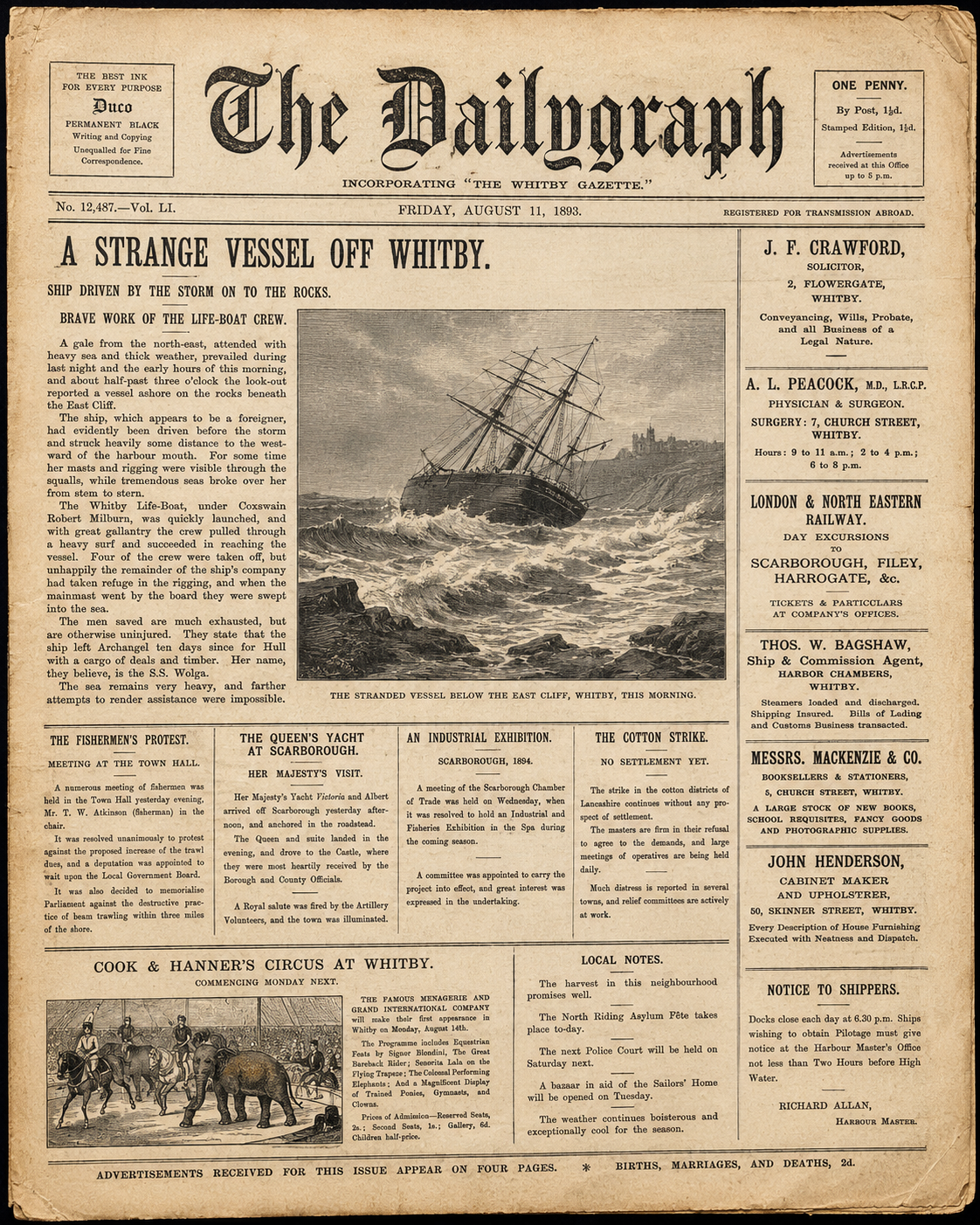
Dracula's arrival in England occurs aboard the Demeter. The ship's log records the systematic disappearance of the crew. When the vessel runs aground at Whitby, the captain is found dead, tied to the wheel. A large dog leaps ashore. Dracula enters England.
Lucy's condition progresses through repeated nocturnal attacks: blood loss, pallor, weakness, and puncture marks at the throat. Mina attempts to protect her but cannot prevent further access. Lucy's mother dies suddenly, removing a key barrier. Wolves are driven against the house, allowing Dracula to enter again and continue feeding.
Dr. John Seward, director of an asylum near Carfax Abbey, treats Lucy and records his cases using a phonograph. Among his patients is R. M. Renfield, who consumes insects and animals to accumulate life force and reacts to Dracula's presence before it is visible. His behavior anticipates the Count's movements.
Professor Abraham Van Helsing is brought in and identifies Lucy's condition as vampirism. Multiple transfusions are performed using blood from Arthur Holmwood, Quincey Morris, Seward, and Van Helsing. These measures only delay the outcome. Dracula continues to feed on Lucy at night, reversing any temporary recovery. Lucy dies.
After her burial, reports emerge of a figure known as the "Bloofer Lady" preying on children in Hampstead Heath. The group confirms that Lucy has returned as a vampire. Van Helsing directs her destruction through staking, decapitation, and ritual measures, ending her activity.
Harker returns to England and confirms that the Count he encountered in Transylvania is the same entity now operating in London. Mina compiles all available records — diaries, letters, telegrams, and phonograph recordings — into a unified system. This allows the group to reconstruct Dracula's movements and identify his network of properties, including Carfax and additional locations where his boxes of earth are stored. These sites are systematically located and neutralized.
Dracula retaliates by entering Mina's room and forcing her to drink his blood, establishing a direct connection. This places her at risk but also enables the group to track Dracula's movements through hypnotic sessions conducted at sunrise and sunset.
Renfield attempts to resist Dracula's influence and confronts him. He is violently attacked and mortally injured. Before dying, he provides critical information confirming Dracula's actions and intentions.
As Dracula abandons England, the group organizes a coordinated pursuit across Europe toward Transylvania. Mina, partially under Dracula's influence, provides directional insight during hypnosis. The group divides to intercept the Count before he can regain full strength within his territory.
Near Castle Dracula, they intercept the convoy transporting his box of earth. The attack occurs at sunset. Jonathan Harker cuts Dracula's throat while Quincey Morris drives a knife into his heart. Dracula disintegrates immediately. Quincey Morris dies from his wounds.
The narrative concludes with a retrospective account assembled from the collected documents. Mina survives and is freed from Dracula's influence. The entire novel remains constructed through diaries, letters, telegrams, and recorded testimony, maintaining its documentary structure without an omniscient narrator.
Bram Stoker · 1847–1912
© Dr. Enrique A. Palafox · Dracula Legacy
Dublin, Ireland · 8 November 1847 — London, England · 20 April 1912
Stoker was not primarily a novelist. He spent 27 years as business manager of the Lyceum Theatre in London for actor Henry Irving — writing up to 50 letters a day on his behalf, managing international tours, and cultivating the leading figures of Victorian cultural life. Dracula was a parallel project, constructed slowly in the margins of that career.
He began research in 1890. Seven years of notes on Transylvanian geography, Eastern European folklore, and the structure of an epistolary narrative produced a typescript titled The Un-Dead — changed at the last minute. Published 26 May 1897. Stoker received no royalties on the first 1,000 copies sold.
Henry Irving — who refused to play Dracula, calling the manuscript "dreadful" — is widely considered the biographical model for the Count. Stoker's circle included Arthur Conan Doyle, Oscar Wilde, Walt Whitman, Alfred Lord Tennyson, and Mark Twain. He died aged 64. His ashes are held at Golders Green Crematorium, London. He saw no film adaptation of Dracula.
Historical public record · Not affiliated with the Bram Stoker Estate · Dracula Legacy transmedia project — Dr. Enrique A. Palafox →
Archibald Constable & Co.
Westminster · London · 1897
Harrison & Sons, printers
Yellow cloth · Red lettering
2 Whitehall Gardens, Westminster · Published 26 May 1897 · Six shillings
The contract — a memorandum with Stoker's handwritten amendments, initialled 20–25 May 1897 — specified a minimum run of 3,000 copies at six shillings. Stoker received no royalties until the first 1,000 sold. First issue copies are identified by the absence of an advertisement for The Shoulder of Shasta on the final leaf. Text block on uncoated wove paper; the eight-page catalogue on laid paper.
The yellow cloth was not convention. In 1894–1897, yellow was the colour of The Yellow Book — a deliberate signal of anti-conventionality and modernism. High-contrast red lettering on saturated yellow was both genre signal and bookseller visibility device. No document from Constable survives explicitly justifying the choice. No dust jacket has been documented for any 1897 copy.
Approximately 102 pages were cut before publication — including the chapter now known as Dracula's Guest (published 1914) and the original ending: the volcanic destruction of Castle Dracula. The typescript was discovered in a Pennsylvania barn in 1984 and sold at auction in 2002 for $941,000. The calendar Stoker used was the real calendar of 1893 — every date in the novel corresponds to an actual day of that year.
Original 1897 text · Annotated editions · Audiobook available
Get the Original Dracula on Amazon →Dracula by Bram Stoker (1897) · Magic Lantern Exhibition
Secondary Characters in Dracula by Bram Stoker (1897)
Three vampires in Castle Dracula who attack Harker. They embody transgressive female sexuality unbound from Victorian convention.
Found dead lashed to the wheel when the Demeter runs aground at Whitby. His log records the crew's disappearance one by one.
Elderly Whitby fisherman who befriends Mina. Found dead the night the Demeter arrives — Dracula's first English victim.
Nursing sister in Budapest who cares for Jonathan after his escape. She alerts Mina of his condition.
Romani band in Dracula's service who guard his boxes of Transylvanian earth. They are the final convoy the hunters must intercept.
Lucy's mother. Her blunder — removing Van Helsing's garlic — opens the window for Dracula's decisive attack. She dies of shock that same night.
Russian sailors who vanish during the voyage from Varna to Whitby — their disappearances document Dracula's sea crossing.
Mysterious driver at the Borgo Pass — later revealed to be Dracula himself, using blue flames and wolves to manage the journey.
Jonathan Harker's employer who assigns the Transylvania commission. Dies during the novel and leaves the firm to Jonathan.
Curated and directed by Dr. Enrique A. Palafox as part of the Dracula Legacy transmedia project · Original text by Bram Stoker (1897)
This is not a standard commercial reprint. It is a controlled archival reconstruction of the original 1897 editorial object.
Its purpose is to reproduce, with verifiable precision, the Victorian reading experience while preserving typographic integrity, original errors, and historical page composition.
Facsimile cover reconstructed from the 1897 first edition.
The octavo format, yellow cloth boards, and blood-red lettering reproduced under conservation criteria from an original held in a private collection in Mexico.
Rather than adapting or updating the novel, this edition reconstructs the original reading object through a controlled editorial restoration process. The goal is not reinterpretation, but documentary fidelity.
The work approaches Dracula as a historical artifact of print culture: a designed object whose typography, rhythm, spacing, and material logic form part of the reading experience itself.
The edition was developed through a reconstruction pipeline grounded in direct documentary reference and visual validation against the original source.
Direct access to an original 1897 first edition copy held in a private collection in Mexico. Authorized page-by-page photographic capture.
Direct photographic documentation of each page, registering texture, wear, and ink variation.
Perspective correction, alignment, and noise cleaning without altering the original structure.
Replication of original tracking, line spacing, and typographic weight, preserving archaic forms, irregularities, and printing variations.
Contrast and ink density adjustment in Photoshop, with attention to historical fidelity and without artificial aging effects.
Faithful page reconstruction validated visually against the primary source.
The result is a master file built under conservation criteria rather than editorial modernization.
Interior page preserving the original typographic structure.
Chapter I opening. Jonathan Harker's Journal, 3 May. Original tracking, spacing, and printing variations reproduced without modern substitution.
This edition incorporates an augmented reality layer through the Artivive app, activated on the cover and dedication page.
Rather than functioning as a decorative add-on, the digital layer extends the restored object into a transmedia artifact, connecting physical book history with contemporary narrative activation.
Historically consistent material object.
Reliable textual and editorial reference.
Case study in reconstruction methodology.
Access to the novel through its original editorial logic.
This edition occupies the space between archival reproduction, critical object, and functional collectible.
It does not adapt the text.
It does not modernize it.
It restores it.
The project is directed by Dr. Enrique A. Palafox under a framework of literary archaeology, forensic editorial reconstruction, and transmedia integration.
Its value lies in the integration of original text, historical editorial form, digital layer, and specialized curatorial oversight.
© Dr. Enrique A. Palafox — Dracula Legacy / The Book of Dracula
Original transmedia research and visual reconstructions based on Bram Stoker's 1897 novel.
2017–Present. All rights reserved.
For the Dead Travel Fast
First Edition Cover · Archibald Constable · London
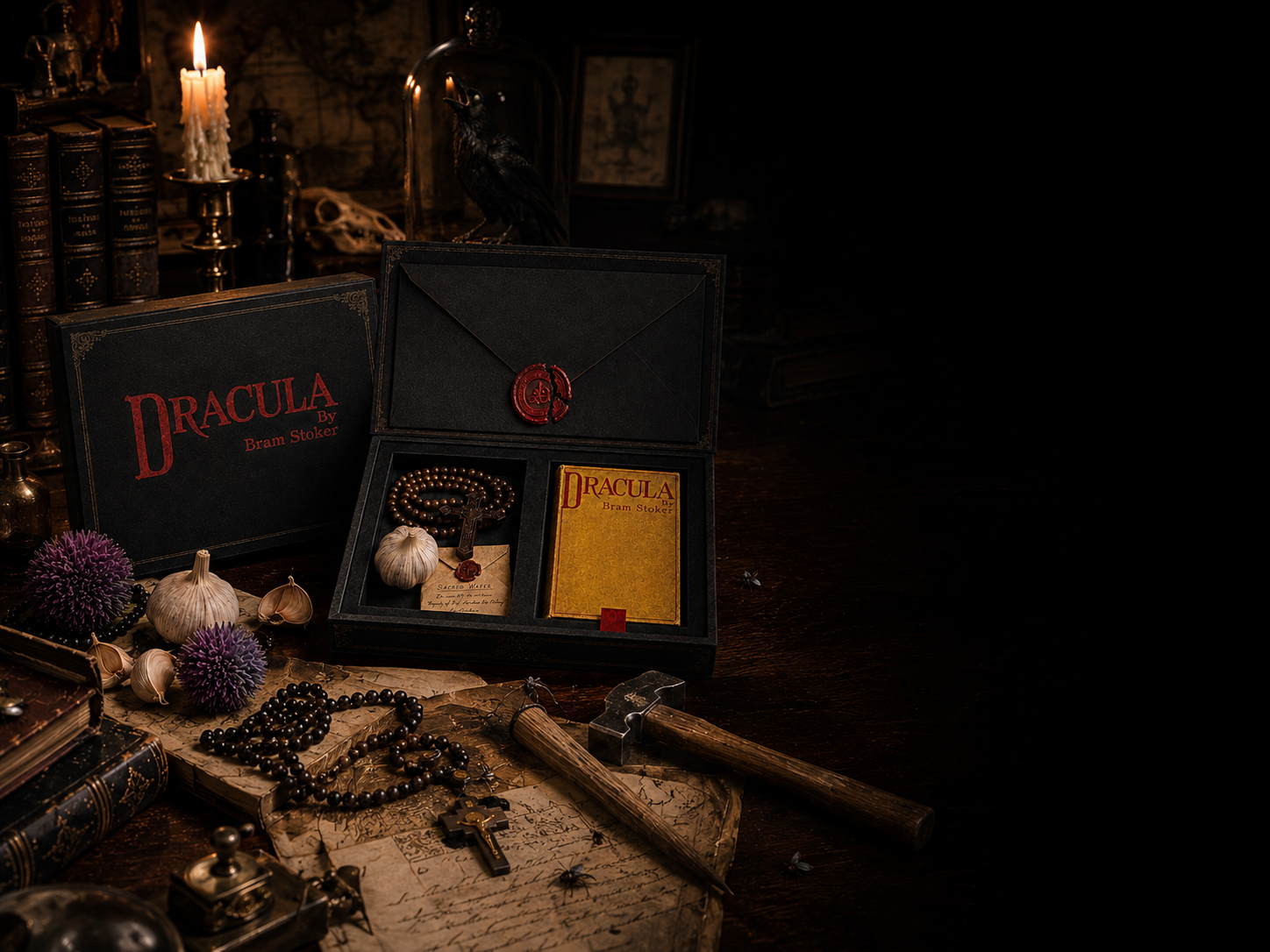
Produced directly from the first edition cover of Dracula by Bram Stoker (1897) — the yellow cloth boards with blood-red lettering published by Archibald Constable, London. Not a tribute. A faithful material object derived from the text's first public form.
Objects in this archive circulate in limited cycles. Availability is not permanent. No reposition is guaranteed once a run concludes.